home

ARREST THE POPE? WHY NOT?

Arrest the Pope? Why not?
Last night I watched a panel of journalists on BBC’s Dateline London discuss the Pope’s direct role in the cover up and protection of paedophiles in the Catholic order.  I realized with a bit of a shock, that the discussion was not about whether the Pope was responsible or not; with all kinds of evidence pouring out from all corners of the world, and a BBC documentary, the Pope’s explicit role in all this was irrefutable.  What the BBC panelists were discussing – was what could now be done with the Pope.
Suddenly one of the panelists said something like, “Well you cannot possibly arrest the Pope!”
And I immediately thought, why not?
If this was any other large, multinational organization with evidence of harboring an international ring of paedophiles, would not the topmost authorities be immediately liable to investigation and police action? If the CEO of that organization had this kind of direct evidential pile-up against him of actually leading the cover-up would he not be put under arrest?
So what excuses the Pope is what I would like to know?

Will the Indian Woman Challenge Her God?

ParineetaSarat Chandra Chattopadhyay is one of my grandmother’s favorite novelists, and she says so with an air of superiority. To like Sarat Chandra is to be acknowledged as a true connoisseur of literature in India.

So it is at the risk of being rebuffed that I say this:  Sarat Chandra's novels, particularly at the storyline level really get up my nose. I have tried reading them through all kinds of lenses—rose tinted, myopic, historic etc. etc. but they seem to always end up in the same place.

The female protagonist is always bovine and sweet-tempered. She has all but trashed her sense of self and individuality, and happily submits to the whims of her male counterpart, her family, and society, serving them all diligently, and allowing them to do with her life whatever they please. The male protagonist is almost a mirror opposite – self-seeking, irresponsible, thick-skinned and narcissistic. He believes that the world – including his family and the female protagonist are there to serve him and submit to his will. This in a nutshell is Sarat Chandra's idea of an ideal male-female relationship.

The Potato Cartel


March 24, 2010

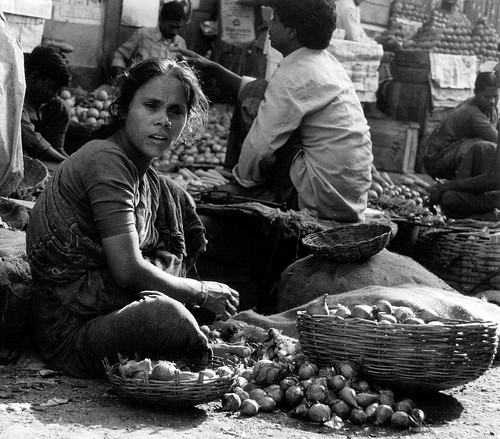
A young potato farmer, Maktabul Hussein, only 18 years old, committed suicide today in Jalpaiguri, (West Bengal, India). Why? Because the price of potatoes have dropped so much that he could not make up the money to pay back the Rs. 500,000/- loans he had taken to cultivate his crop.

Maktabul was getting only Rs. 1.80/kg for his potatoes. And this is what is bizarre! Over the last few months everyone in town has been complaining about how the cost of potatoes has been soaring, along with that of onions, lentils and rice. At one point potatoes was selling for Rs.20/kg! If the middle-class was feeling the pinch, just imagine how it has been for the poor. Potato after all has been the poor’s sustenance! What more – recently the West Bengal government announced that there has been such a surplus of potatoes that they are going to be exporting them!

What are we supposed to gather from this? Is there a potato cartel at work here? That odious middle-man? Does he hoard the potatoes – and rips off the poor farmer who breaks his back cultivating it. And then turns around rips off the customers by charging them 10 times the cost?

The book Needless Hunger -- explains how this is the kind of mechanism that created an artificial famine in Bangladesh when thousands died of hunger.

Needless Hunger: Voices from a Bangladesh Village

Female Genocide With a Question Mark?


As an administrator of the 50 Million Missing Campaign against female genocide in India, one of the most frustrating challenges I face is when people question the term “female genocide”.   Even more puzzling is if I ask ‘why?’ I don’t get a definitive explanation!
I lay bare these facts:  More than 50 million women have been killed in India over 3 generations.  EVERY YEAR -- more than a million unborn girls are selectively aborted; thousands of new born girls are strangled, poisoned, drowned or buried alive;  girls under 5 are 40% more likely to die than boys the same age because of starvation and deliberate neglect (their parents don't think girls are worth spending on); more than 25000 young married women are murdered for dowry; thousands more are tortured; 1 Indian woman is dead every 5 minutes because of pregnancy complications often due to forced and repeated abortions to rid the girls. Companies are now selling kits online to select out girls even before they are conceived!
Females in India are killed because they are regarded as undesirable -- but usable and disposable objects.  Like victims of any genocide.  Then why is this systematic dehumanization of women and their massive annihilation not recognized as ‘genocide’? 

The Pink Panties Movement in India

The Pink Panties Campaign:
The Indian Women's Sexual Revolution

First published in Intersections: Gender and Sexuality in Asia and the Pacific Issue 23, January 2010

...
However, what is interesting, is that if India's historical traditions are the determinants of what the culturally- and socially-acceptable limits are to be of women's sexual roles in modern India, then India's long, chequered past throws up quite an assorted mix of options. While on one hand, way back in the first millennium B.C.E. women in the ancient Vedic texts were regarded as vixens, sexually promiscuous and opportunistic, who not only swindled men of their precious semen but through their menstrual blood inflicted pain, torture and even death on men, then the first millennium C.E. provided a radically different vision of women's sexuality and sexual freedom. Not only do the texts from this period declare that women had the same rights and freedom to enjoy sex as men did, but that they too could indulge in it for pure pleasure and not simply for reproduction. Moreover, the kamasutras speak of the issues of female orgasm, how different it is for women than for men in that it is foreplay and not coition that leads to orgasm in women, and how it is men who need to know and understand how to pleasure their female partners. Data from this period indicates a tremendous degree of freedom and choice for women in selecting their sexual partners, even if they were married, and in expressing their sexual needs and wants.   Read more >>

Relevant Books

The Emergence of Feminism in India, 1850–1920
Indian Feminisms: Law Patriarchies and Feminism in India
Toward a Politics of the (Im)Possible: The Body in Third World Feminisms (Anthem Press India)
Feminism in India (Issues in Contemporoary Indian Feminism)
Motherhood in India: Glorification without Empowerment?
Urban Women in Contemporary India: A Reader
Women in India: Women's rights, India, Dowry, Dowry death, Sex-selective abortion, Feminism in India, Women in Sikhism, Women in Hinduism, Sexism in India, List of Indian women in dance
Sex and Power: Defining History, Shaping Societies


.

Indian Women in Pubs -- A Crime?

Indian Women in Pubs -- A Crime?

First published in Fight-Back website.

A group of women, who are out for the evening at a pub, get thrashed and sexually molested. This is filmed and flashed on T.V., so all of India sees...One would expect a fleet of police cars to rush into action, lights flashing, sirens blaring, to arrest those baboons, the T.V. cameras still rolling, so a clear message is sent out to all those other baboons watching in India: This is criminal activity. And it will not be tolerated.

But No. With women in prime positions of power...the government and its agencies tip-toe gingerly around the case like cats on a hot tin roof, hoping things will cool down, so they can go away and pretend it never happened. Why? What is it that brings the government so close to selling the constitution to the raddi-walla? Read more >> 

For Rita's other published works click here
 

Out of the Box (How India deals with pornography)

First published in India Today, November 26, 2009.

46 per cent of married men and 64 per cent of married women [in India] say they would not see porn films with their partner. While it is all right for the married to reproduce in India, it is indecent for them to admit to indulgence in sex for pleasure.
Indeed, the father of our nation was vociferously opposed to married couples having sex for pleasure. Gandhi declared the sole purpose of sex was reproduction. And if couples intended not to make babies, then they shouldn't even be sleeping together. . .

It is a pity though that modern India does not seek its sex education from the gurus who preceded Gandhi by about 1,500 years, and not only wrote mammoth anthologies on sex but were so versatile in their knowledge of it that they were bestowed with the title of acharya. It would have solved many of our current sex-related problems, including overpopulation and squeamishness about porn.
India's ancient sexologists proclaimed that sex solely for the purpose of reproduction is what animals do. For humans, the aim is pleasure. And they asserted this applied to women as well. This pleasure was to be attained through the stimulation of each of our senses-sight, sound, touch, taste, and smell, as well as intuition and balance was expounded on in the Kama Sutras. Read more here..

For Rita's other published works click here